Three-Tier MTSS Model
The MTSS framework uses a multi-level prevention system with three tiers of support that vary in intensity. Students may receive interventions and/or supports in academics, behavior, social-emotional learning, attendance, speech/language, English Language Learner (ELL) services, wraparound services, and mental health supports.
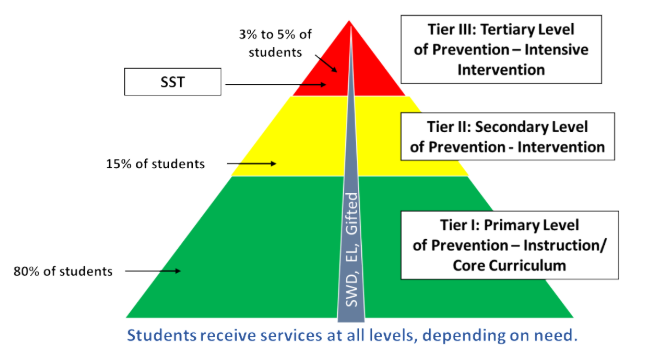
Students receive services across tiers based on need. Percentages are approximate; the supplied graphic uses 80%, 15%, and 3–5%.
Tier I: Primary LevelCore Instruction · 80–90%
Tier I, the primary level of support in MTSS, serves all students (about 80–90%) through high-quality, standards-based instruction in the general classroom. It includes universal academic and behavioral supports with differentiated instruction to meet diverse needs. This level is preventative and proactive, using universal screening and data to evaluate and improve instructional effectiveness.
Tier II: Secondary LevelTargeted Instruction/Supports · 5–15%
Tier II, the secondary level of MTSS, serves students who need additional support, typically about 5–15% of the student population. At this level, students receive targeted small group interventions and supplemental instruction aligned with Tier I to address specific skill gaps. Progress is monitored more frequently, and data is used to determine how well students are responding to interventions. Based on this data, instructional adjustments are made to ensure students receive the support needed to improve.
Tier III: Tertiary LevelIntensive Intervention · 1–5%
Tier III, the tertiary level of MTSS, serves students with significant needs, typically about 1–5% of the student population. At this level, students receive intensive, individualized interventions tailored to their specific challenges, along with frequent progress monitoring to track improvement. Support may involve the Student Support Team (SST) and other specialized services. Tier III is characterized by highly personalized instruction, which may include special education or wraparound services, and ongoing team-based problem-solving to ensure students receive the most effective support.